Herat · Afghanistan
Afghan Rugs, Woven by Hand in Herat
Every carpet that leaves Khorasan Weaving House is tied knot by knot on an upright loom in Herat, in hand-spun wool coloured with natural dyes. This is a short guide to what an authentic Afghan rug is, how ours are made, and what to look for before you buy one.
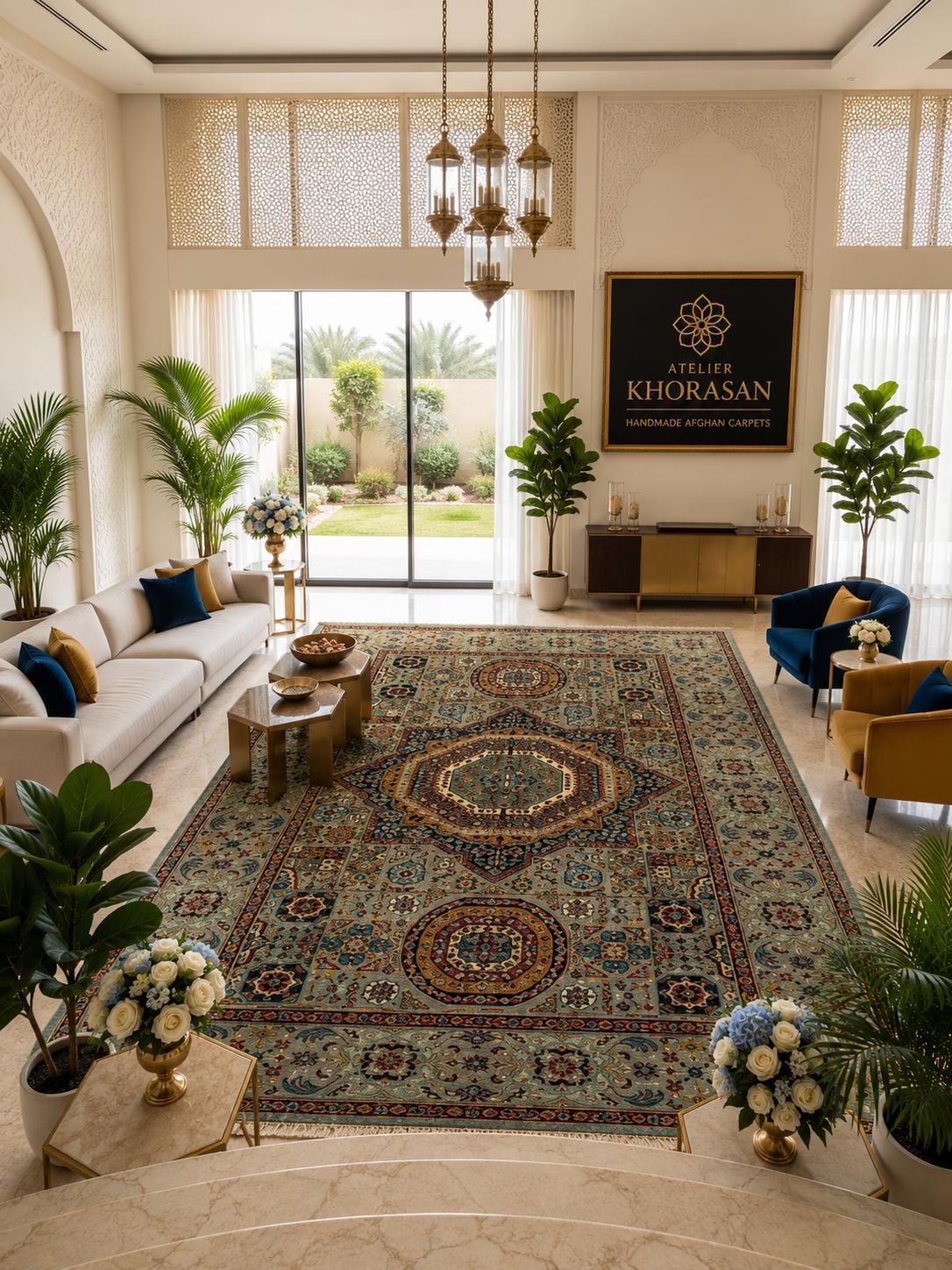
Where our Afghan rugs come from
Herat sits in western Afghanistan, in the historical region of Khorasan — a crossroads of weaving traditions for centuries. Our weavers work in and around the city, on looms that have not changed in their essentials for generations.
Because the work is done by hand, no two carpets are identical. Slight variations in the line of a border or the depth of a colour are evidence of the hand, not defects.
How a hand-knotted Afghan rug is made
The sequence is slow and deliberate. Each stage is completed by hand before the next begins.
- Wool selection and hand-spinning, which gives the yarn its irregular, light-catching character.
- Natural dyeing in small batches, so colour deepens rather than fades.
- Dressing the loom: the warp is tensioned on an upright wooden frame.
- Knotting: the pattern is tied by hand, row by row, at roughly 350,000 to 900,000 knots per square metre.
- Shearing the pile to an even height, then washing and drying in the sun.
- Final finishing, edge binding and inspection before the carpet is released.
Judging quality before you buy
Turn the carpet over. On a hand-knotted rug the pattern is visible on the back as individual knots, and the fringe is a continuation of the warp rather than a strip sewn on. Machine-made rugs show a uniform grid and a glued or stitched edge.
Then consider wool and colour. Hand-spun wool feels alive and slightly uneven; natural dyes shift subtly across the field, an effect called abrash, which is a mark of authenticity rather than a flaw.
Sizes we weave
We weave to three principal formats and to commission: roughly 4 m² for a salon, 9 m² for a reception room, and 12 m² for a grand hall. Any size, palette or design can be commissioned through our bespoke service.
Questions
- What makes an Afghan rug different from other handmade rugs?
- Afghan rugs are hand-knotted on traditional looms, most often in highland wool, with designs passed down within weaving families. In Herat, where our looms stand, the tradition leans toward fine knotting and restrained, architectural pattern rather than loud colour.
- Are Afghan rugs good quality?
- Quality depends on the wool, the dye and the knot density rather than the country alone. Our carpets are woven at roughly 350,000 to 900,000 knots per square metre in hand-spun wool, which is what gives a hand-knotted rug its density underfoot and its long life.
- How are Afghan rugs made?
- Wool is sorted, spun and dyed, the warp is dressed on an upright loom, and the pattern is then tied knot by knot by hand. The pile is trimmed, the carpet washed and sun-dried, then finished and inspected. A large carpet can take many months.
- How do I care for a hand-knotted Afghan rug?
- Vacuum gently without a rotating beater bar, rotate the rug once or twice a year so light and footfall fall evenly, blot spills immediately rather than rubbing, and have it professionally hand-washed rather than machine cleaned.
Continue
- Hand-knotted wool rugs explained →
- Khorasan carpets and their tradition →
- Herat carpets: the city and its looms →